A positioning statement for a creator offer is one sentence that names who the offer is for, what they're stuck on, and the mechanism that fixes it: "For [a specific person stuck in X], this is the [mechanism] that [outcome] instead of [what they've already tried]."
Most creators write theirs backwards.
They start with the product. They list the features. They end with something like "helping creators grow faster."
That's not a positioning statement. That's a sentence that fits a thousand other creators, so it sells for none of them.
I've sold 1,300+ digital products to an audience of 75,000 on X and 18,000+ newsletter subscribers. The offers that sold weren't the ones with the best features. They were the ones where one specific person read the first line and thought: that's me.
Here's how to write that line.
(You'll also see this searched as a "position statement." For a creator offer it means the same thing. It isn't the kind of position statement a nonprofit publishes to state its stance on an issue.)
What a positioning statement is (and isn't)
It is a sentence that says who the offer is for and why it's different from what they've already tried.
It is not:
- A tagline. A tagline is the short, memorable line that sits on top. The positioning statement is what it's built from.
- A bio. "Accelerating creators with AI by showing how to use AI to start, create, grow, and scale faster" is a good line for who I am. It would be a bad line for a single offer. It's too broad to tell any one buyer "this is for you."
- A list of features. Features are what's in the box. Positioning is who opens it and why.
If you've been following this series, positioning is where the work in The Repeated Question Is the Offer lands. You found the question. Now you say, in one sentence, who it belongs to.
The formula
Four parts. Every one has to be specific.
For [specific person] stuck [in this situation], this is the [mechanism] that [outcome] instead of [what they've already tried].
- Specific person. One buyer you could describe to a friend. Not a demographic.
- Stuck point. The situation they're in right now. Use their words, not yours.
- Mechanism. What the offer actually is, and why it works where the usual fix doesn't.
- Alternative. What they've already tried. This is what makes it a different thing, not a better version of the same thing.
A real example
Here's a positioning statement from a real AI Offer Crafter run on a solo newsletter writer's content:
For solo newsletter writers stuck rewriting from scratch every week, this is the persistent skill system that turns Claude into a Substack Employee instead of a vending machine.
Break it down:
- Specific person: solo newsletter writers. Not "creators," not "writers."
- Stuck point: rewriting from scratch every week.
- Mechanism: a persistent skill system, not a prompt.
- Alternative: the "vending machine," meaning the ChatGPT-with-a-saved-prompt routine they already tried and got generic output from.
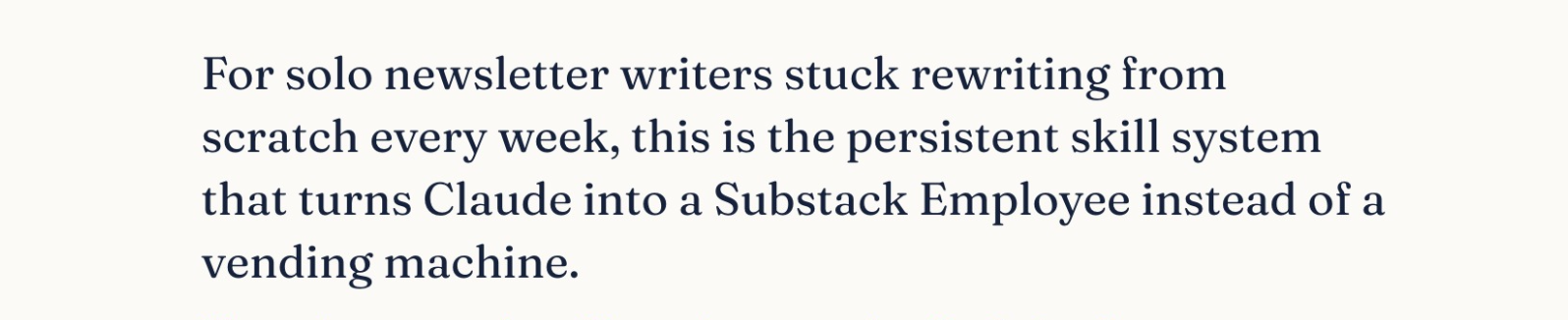
Notice what it doesn't say. It doesn't say "save time" or "write better." Those would fit any writing tool. The mechanism and the alternative are what make it this offer and no other.
If you want to see how that statement sits next to the pricing, proof and guarantee, I ran the tool on a real newsletter and showed the whole output.
How to write yours in about 45 minutes
Step 1: Start with the repeated question
Pull the one question your audience keeps asking you for free, in their exact words. If you haven't found it yet, How to Find Your Repeated Question in 30 Minutes takes half an hour.
The question tells you the problem and the person. Someone asking "how do I stop starting from a blank page every Sunday?" has already told you who they are.
Step 2: Name one specific person and their stuck point
Write one sentence about a single buyer. Where are they stuck? What have they already tried?
Here's the truth: if you're tempted to write "anyone who wants to...", you haven't chosen yet. Pick the person who asks the question most often, or the one furthest along who will pay fastest.
Step 3: Name the mechanism
This is the step most people skip.
What is the offer, and why does it work where the usual fix fails? A template pack, a done-with-you build, a system, a weekly audit: pick the one thing it is. Then say what the alternative gets wrong.
In the example above, the alternative (chat sessions that reset) fails for a structural reason, and the mechanism (a system that persists) fixes exactly that. That's a mechanism, not a feature.
Step 4: Write the sentence
Fill in the formula. Write it ugly first. Then cut every word that doesn't name the person, the stuck point, the mechanism or the alternative.
Aim for one or two sentences, about 25 to 40 words. If it runs longer, you're describing the offer instead of choosing who it's for.
Step 5: Test it before you publish it
Three quick checks. These are rules of thumb I use, not a formal test:
- The swap test. Replace your product name with a competitor's. If the sentence still works, it's too generic.
- The "not for" test. Can you name someone it's not for? If everyone is a fit, no one will feel it's theirs.
- The vocabulary test. Read it next to the exact phrases from your audience's messages. If you used words they never use, rewrite it in theirs. I build a language bank from existing content for exactly this reason.
The mistakes I see most
- The category is too broad. "For creators" or "for entrepreneurs" fits everyone and persuades no one.
- Outcome without mechanism. "Grow your audience faster" doesn't say why it works, so it sounds like every other promise.
- Mechanism without a person. "A 3-agent system" means nothing to a buyer who doesn't know it's for them.
- Borrowed words. If it sounds like marketing, your audience won't recognise themselves in it.
Where it goes
Put it at the top of your offer page, in the first line of your pitch, and in your outreach messages. Then test it. A validated offer is one where someone who isn't you has said yes, so ask five people in your audience whether the sentence describes them.
Frequently asked questions
What is a positioning statement for a creator offer?
A positioning statement for a creator offer is one sentence that says who the offer is for, what they are stuck on, what the offer is, and why it works better than what they have already tried. It is written for the buyer, not as a brand slogan, and it should make the right person think that's me, and everyone else move on.
What is the difference between a positioning statement and a tagline?
A positioning statement says exactly who the offer is for and what makes it different, so it can be tested against real buyers. A tagline is a short, memorable line that sits on top of it. Write the positioning statement first, then compress it into a tagline.
Is a position statement the same as a positioning statement?
For a creator offer, yes: people search for both. Do not confuse it with the organizational position statement a nonprofit or professional body publishes to state its stance on an issue. A creator's positioning statement describes who an offer is for and why it is different.
How long should a positioning statement be?
One or two sentences, around 25 to 40 words. If you need a paragraph, you are still describing the offer instead of choosing who it is for. A longer internal version is fine, but the version you publish should be short enough to say out loud in one breath.
Where to go from here
Positioning is only as strong as the offer under it. If you haven't yet, run the offer through The 12 Questions Every Creator Offer Must Survive, then price it with Why Creator Pricing Is Almost Always Wrong. And if you're still unsure what to sell, start with What Should You Actually Sell?.
Have AI Offer Crafter write the positioning statement for the offer already in your content →