What you should sell to your audience is almost never a new idea — it's the thing you already do for free, on repeat, that people keep asking you for more of.
"What should I sell to my audience?"
That message, or some close variation of it, is one of the most common things that lands in my DMs. Not from people with no audience — from people with a newsletter, a following, months or years of published work. People who clearly know how to create. People who are stuck on that exact question.
Here's the part that surprises most of them: the question is the trap. Not because it's a bad question, but because it sends people looking in the wrong direction — toward brainstorming, toward "finding an idea," toward staring at a blank doc titled "product ideas" until something feels exciting enough to build.
That's backwards. You don't need a new idea. You need to stop overlooking the one you already have.
The idea you're waiting for already exists
If you've read The Repeated Question Is the Offer, you already know the core mechanic: the question your audience asks you over and over, for free, is already validated demand. And if you've checked your content against 5 Signs Your Content Already Has an Offer In It, you probably recognized at least a couple of them in your own work.
So if the signals are already there, why does "what should I sell" still feel unanswered for so many creators?
Because recognizing a signal and turning it into a product decision are two different skills. Knowing you have an offer in your content isn't the same as knowing exactly what to package, price, and put a buy button on. That gap — between "yes, this resonates" and "here's the specific thing I'm building" — is where most creators get stuck for months.
You're not short on ideas. You're short on permission.
Talk to enough creators who are stuck on this and a pattern shows up fast: they usually already know what they could sell. They just don't believe it counts.
"It's just the thing I already answer for free."
"It's not innovative enough — anyone could Google this."
"I don't want to charge for something that feels obvious to me."
That last one is the tell. If something feels obvious to you, it's because you've done it enough times that the difficulty has disappeared from your own view. It hasn't disappeared for the person asking you about it in a DM at 11pm. To them, it's still the exact problem they can't solve on their own — which is precisely why they're asking you, not searching it themselves.
You don't need permission to charge for it. You need to stop measuring it against how hard it feels to you, and start measuring it against how much it's worth to the person who doesn't have it yet.
Three places your actual offer is already sitting
Instead of brainstorming from scratch, audit what's already there:
1. Your DM archive. Scroll back 90 days. Look for the question that keeps showing up — not similar questions, the same question, from different people, in roughly the same words. That's not a coincidence, and it's not a niche concern. It's a pattern with a price on it.
2. The content people save and reference, not just like. A like is a passive nod. A save is someone saying "I'll need this again." Whatever you've published that gets bookmarked and referenced back to is functioning as reference material already — which means there's demand for a more complete, more structured version of it.
3. What you talk people through on calls. If you've ever gotten on a call, in a DM voice note, or in a comment thread and walked someone through your actual process step by step — that walkthrough is a product outline. You've already built it once. You just built it for free, for one person, and then let it disappear.
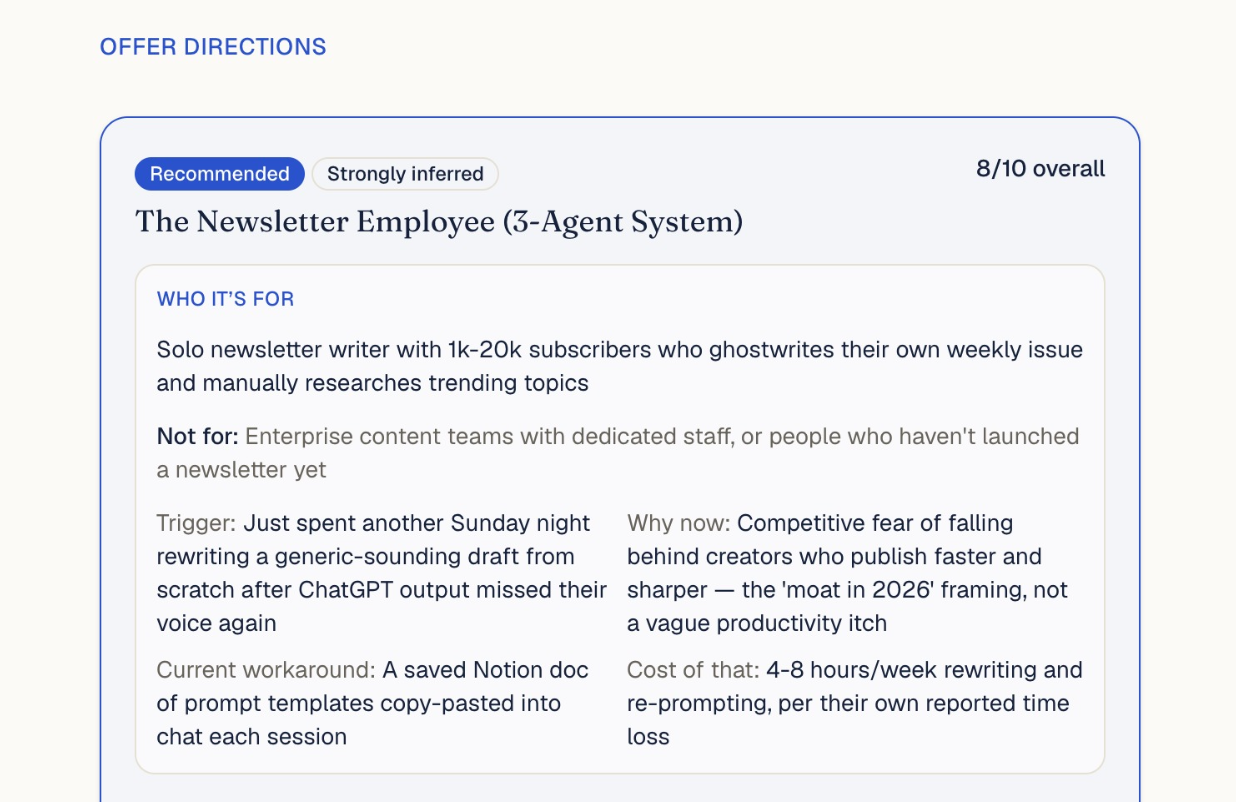
This is exactly what running your content through AI Offer Crafter does automatically — it doesn't ask you to invent anything. It reads what you've already published and DM'd and surfaces several scored candidate directions, each grounded in a specific person's specific problem, so you're choosing between real options instead of guessing at one.
What to do when you find more than one answer
Most creators who do this audit honestly don't come up empty. They come up with two or three plausible things they could sell — and then freeze again, this time because they don't know which one to build first.
That's a much better problem to have, and it has a much more concrete answer. You don't pick based on which idea excites you most. You score each candidate against the same questions: Who exactly is this for, and who is it explicitly not for? What's the specific trigger that makes them ready to buy now, not eventually? Are they already spending money or time working around this problem some other way?
I've built products that got a hundred "looks great!" replies and sold to three people, and I've built products that got no fanfare at all and sold out in the first week. The difference was never how good the idea sounded out loud. It was whether it matched a problem someone was already paying — in time, workarounds, or money — to avoid.
Frequently asked questions
What should I actually sell to my audience?
The thing you're already doing for free, repeatedly, that people keep asking you to do more of — a repeated DM question, a process you walk people through on calls, or a piece of content you privately think should have been paid. That's your offer. It rarely needs to be a new idea.
Do I need a new idea to have something to sell?
No. Almost every creator who asks "what should I sell" already has an answer sitting in their published content and their DMs — they're just looking past it because it feels too obvious or too small to be a real product.
What if I have more than one thing I could sell?
That's normal, and it's a better problem than having none. The fix isn't picking the flashiest idea — it's scoring each candidate against who's actually asking for it, how badly they need it, and whether they're already paying to solve it some other way.
How is this different from just brainstorming product ideas?
Brainstorming starts from your imagination. This starts from evidence — what your audience has already told you, in their own words, that they need. One produces guesses. The other produces something you already know has a buyer.
The idea isn't missing. It's just unpackaged.
If you take one thing from this: stop treating "what should I sell" as a creativity problem. It isn't one. It's an evidence problem, and you're already sitting on the evidence — in your DMs, in what gets saved, in what you've walked someone through for free more times than you can count.
The next question isn't "what's my idea." It's whether that idea would actually survive contact with a real buyer — which is exactly what I'll get into next.
Once you know what to sell, say who it's for in one sentence: How to Write a Positioning Statement for a Creator Offer.