To validate a creator offer before you build it, run it through twelve pass/fail questions covering the problem, the buyer, the mechanism, and the market — and treat every question you can't answer with evidence as a fail, because a failed question tells you exactly what to fix or test first.
In Why Engagement Doesn't Predict Sales, I argued that the repeated question in your replies and DMs is the real demand signal, not your like count. That gets you a direction worth considering. It does not tell you the direction is worth building.
That's a different test, and it's the one most creators skip. You find something your audience clearly wants, you feel the click, and you start building. Three months later you've got a finished product and a quiet inbox.
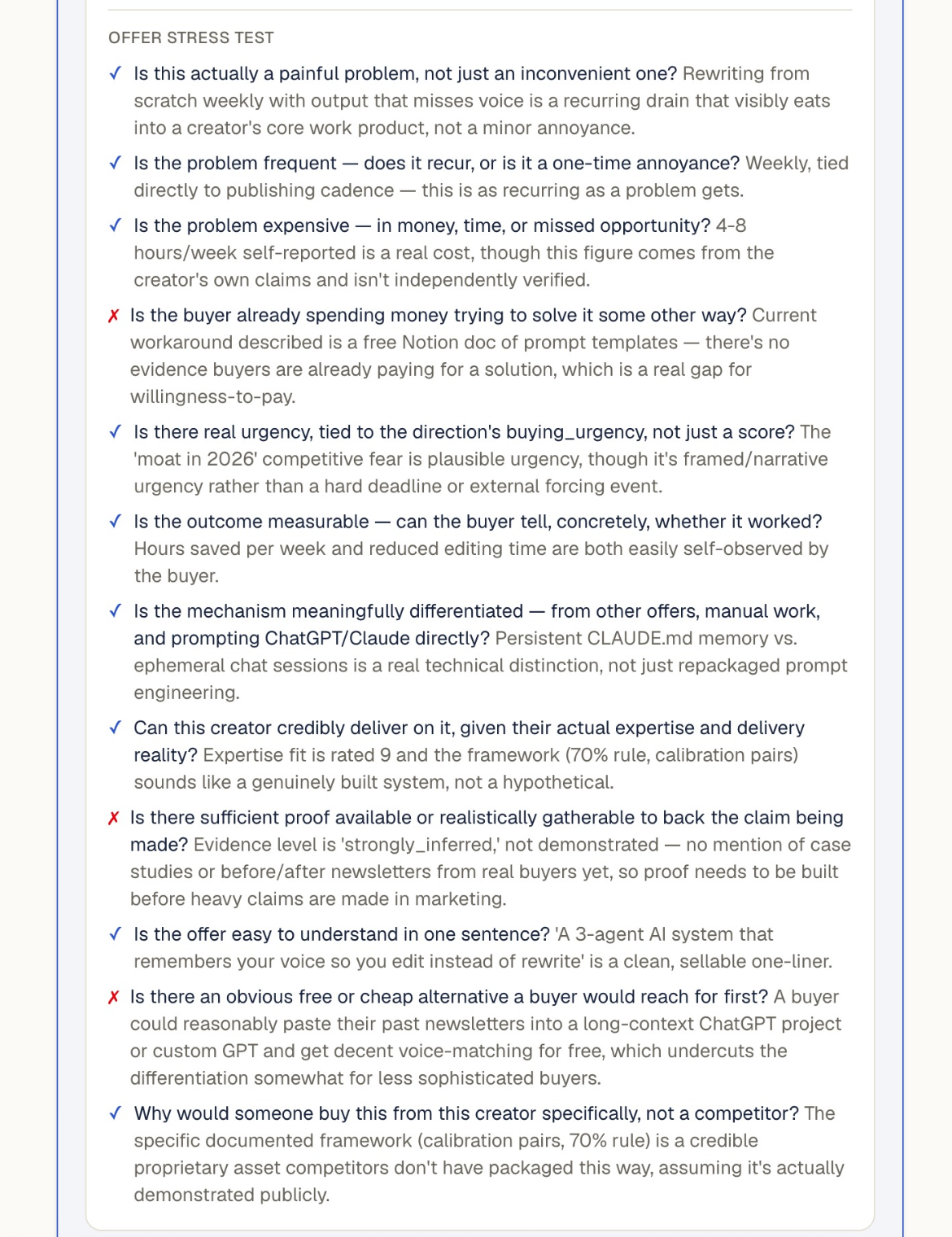
That feeling isn't evidence. So the AI Offer Crafter doesn't stop when it finds an offer. It picks its strongest candidate and then tries to break it, with a fixed stress test of twelve questions, each one answered pass or fail with reasoning. This post walks through all twelve, what a pass and a fail look like, and what the tool said when I ran it on my own idea.
Why a stress test instead of a score
The tool also scores every candidate direction on ten dimensions like urgency, differentiation, and purchasing power. That's useful for ranking options against each other. It's useless for deciding whether to build the winner, because the winner of a weak field is still weak.
A stress test asks a different question: not "which is best?" but "does this survive contact with a skeptical buyer?" It has one rule that matters more than any individual question: each one gets an honest pass or fail, and a test that passes everything has failed at being a test.
I'll use one real run throughout. The direction was called "The Newsletter Employee," a three-agent system built on persistent memory files so a newsletter writer edits instead of rewriting from scratch every week. It came out of my own content, and it was the top-ranked idea, 8/10 overall. That's the kind of offer you'd be tempted to just build. Here's how it did.
Part 1: Is the problem real? (Questions 1–3)
These three check whether there's a problem worth paying to solve. Skip them and everything downstream is guesswork.
1. Is this actually a painful problem, not just an inconvenient one?
Pass looks like: the problem interrupts real work or costs something visible. Fail looks like: people nod along when you describe it and then never do anything about it.
The tool's answer on mine: passed. Rewriting from scratch every week because AI output misses your voice is "a recurring drain that visibly eats into a creator's core work product, not a minor annoyance."
2. Is the problem frequent?
A problem that shows up once a year can't support an offer, no matter how bad it feels in the moment. You want something buyers hit repeatedly, ideally on a schedule.
Passed. The pain was tied directly to publishing cadence, weekly — "as recurring as a problem gets."
3. Is the problem expensive — in money, time, or missed opportunity?
This is the question that later anchors your price. If you can't say what the problem costs, you can't defend charging to solve it. (More on that in the pricing post later in this series.)
Passed, with a caveat worth noticing: the 4–8 hours a week of lost time was real, but it came from the creator's own reported numbers and wasn't "independently verified." The tool passed it and flagged the soft spot in the same breath. That's what honest reasoning looks like.
Part 2: Will money actually move? (Questions 4–6)
A real problem isn't a purchase. These three check the gap between "people have this problem" and "people pay to fix it."
4. Is the buyer already spending money trying to solve it some other way?
This is the sharpest question on the list, and the one most creator offers fail. Pass looks like: your buyer currently pays for tools, freelancers, courses, or subscriptions aimed at this problem. Fail looks like: they're solving it with free workarounds or ignoring it.
Mine failed. The buyer's current workaround was "a free Notion doc of prompt templates," and the tool's verdict was that "there's no evidence buyers are already paying for a solution, which is a real gap for willingness-to-pay."
That's the gap a pain-first search never surfaces: a problem can be real and still have no one paying to relieve it.
5. Is there real urgency?
Urgency isn't "they want this." It's "something is pushing them to act now instead of someday." A deadline, a launch, a cost that's compounding, an event that just happened.
Passed, but soft. The tool called the urgency (fear of falling behind competitors) "plausible," while noting it's "framed/narrative urgency rather than a hard deadline or external forcing event." A pass with an asterisk. Worth knowing before you write sales copy that leans on urgency you can't actually point to.
6. Is the outcome measurable?
Can the buyer tell, concretely, whether it worked? "Feel more confident" fails. "Cut editing time from four hours to one" passes.
Passed. Hours saved per week and reduced editing time are both things the buyer can watch happen themselves.
Part 3: Can you deliver something defensible? (Questions 7–9)
Now the questions turn on the offer itself: is it different, can you deliver it, and can you prove it?
7. Is the mechanism meaningfully differentiated?
The test isn't "is it different from other courses?" It's whether it's different from three things: other offers, doing it manually, and just prompting ChatGPT or Claude directly. That last one is the trap for anyone selling an AI-adjacent product in 2026.
Passed: persistent memory files versus ephemeral chat sessions "is a real technical distinction, not just repackaged prompt engineering." A fail here looks like an offer whose whole value proposition is "better prompts."
8. Can this creator credibly deliver on it?
Notice the question is about this creator, given their actual expertise and delivery reality, not whether the offer is deliverable in the abstract. Plenty of good offers fail this test for the specific person proposing them.
Passed. The tool rated expertise fit at 9 and read the framework behind it (a 70% rule, calibration pairs) as "a genuinely built system, not a hypothetical."
9. Is there sufficient proof available, or realistically gatherable?
Pass looks like: you have results, case studies, or before-and-after examples from real people. Fail looks like: you have a strong theory and your own experience.
Mine failed. The evidence level was "strongly inferred, not demonstrated," with no case studies or before-and-after results from real buyers yet, "so proof needs to be built before heavy claims are made in marketing."
This is the most common fail for first-time offers, and the most fixable. It's also why proof is its own cluster of this series: you don't need more proof, you need the right level of it for the claim you're making.
Part 4: Will it survive the market? (Questions 10–12)
The last three check what happens when the offer meets real buyers who have alternatives and short attention spans.
10. Is the offer easy to understand in one sentence?
If you can't say it in one sentence, buyers can't repeat it to a friend, and word of mouth dies. Mine passed with: "A 3-agent AI system that remembers your voice so you edit instead of rewrite." Clean, specific, repeatable.
11. Is there an obvious free or cheap alternative a buyer would reach for first?
Every buyer has a default option. Your offer has to beat it, not the blank page.
Mine failed. A buyer "could reasonably paste their past newsletters into a long-context ChatGPT project or custom GPT and get decent voice-matching for free, which undercuts the differentiation somewhat for less sophisticated buyers." I'd passed question 7 on differentiation, and this is why one question can't be read alone: the mechanism can be genuinely different and still lose to a free option that's good enough for most people.
12. Why would someone buy this from this creator specifically?
This is the "why you" question. Generic offers compete on price. Offers with a proprietary asset or a real point of view compete on trust.
Passed, with a condition attached: the documented framework is "a credible proprietary asset competitors don't have packaged this way, assuming it's actually demonstrated publicly." Look at that last clause. The pass on 12 depends on fixing the fail on 9. Failures and passes aren't independent, and the tool caught the dependency.
The scorecard: 9 passed, 3 failed, 66/100
Final result on that run: nine passes, three fails (questions 4, 9, and 11), a verdict of Recommend after changes, and an offer score of 66 out of 100.
Two things about that number matter.
First, the offer scored 8/10 in the ranking stage and 66/100 after the stress test. That's not a contradiction. The ranking said it was the best of my options. The stress test said the best of my options still had real problems. Both are true, and only one of them tells you whether to build.
Second, the verdict's reasoning named the actual biggest risk, and it wasn't one of the three failed questions. It was that this was a self-implementation product being sold to people who, by definition, aren't power users of the underlying tool, so some of the target buyers would hit setup friction and ask for refunds. The recommended change before building: add a done-with-you onboarding component, or radically simplify the self-serve path.
That's a sentence most of us won't write about our own offer unprompted, which is the point of running the test.
What to do when a question fails
A failed question is not a kill. It's one of three things:
- A change to the offer. Question 11 failing means reposition, either aim at buyers a free tool won't serve, or add the piece the free option can't replicate.
- A test to run before building. Question 4 failing means you don't know if anyone will pay. Don't guess; run a small pre-sale or paid pilot and let the money answer.
- Work to do first. Question 9 failing means build the proof before you make big claims. Beta users, documented results, a before-and-after.
If you fail four or five, especially across different parts of the test, that's the offer telling you not to build it as-is. The tool is built to say so. That's the difference between a validation step and a packaging step.
How to run this yourself, without a tool
You don't need software to do a first pass. Write the twelve questions on a page. Answer each in one or two sentences, using evidence from your actual audience: real messages, real numbers, real behavior. Then mark each pass or fail.
Two rules:
- If you can't point to evidence, it's a fail, not a "probably." Hope is not evidence.
- If everything passes, you didn't run the test. Go back and argue against yourself on the three you passed most easily.
The same discipline that makes the repeated question work applies here: signal over applause. Your own enthusiasm is applause.
Frequently asked questions
How do you validate a creator offer before building it?
Run the offer through a fixed set of pass/fail questions covering the problem (is it painful, frequent, expensive), the buyer (are they already paying, is there urgency, can they measure the result), and the offer itself (is it differentiated, deliverable, provable, and easy to explain). Any question you can't answer honestly with evidence is a failed question, and failed questions tell you what to fix or test before you build.
How many questions should an offer stress test have?
Enough to cover the problem, the buyer, the mechanism, and the market. The AI Offer Crafter uses twelve, and the number matters less than the rule that each one gets a real pass or fail with reasoning. A stress test where everything passes hasn't tested anything.
What should I do if my offer fails a stress-test question?
A failed question is not an automatic kill. It's one of three things: something to change in the offer, something to test with real buyers before you build, or a genuine reason not to build it. A failed proof question means gather proof first. A failed "are they already paying" question means run a pre-sale before writing anything.
Can I stress-test my own offer without a tool?
Yes. Write each of the twelve questions down, answer them in one or two sentences using evidence from your actual audience (not your hopes), and mark each pass or fail. The hard part isn't the questions, it's being willing to write "fail" next to an offer you're excited about.
Where to go from here
If you haven't found a direction to test yet, start with The Repeated Question Is the Offer and What Should You Actually Sell to Your Audience?. If you want to see the full analysis this stress test came from, I Ran the AI Offer Crafter on My Own Content and Didn't Pick Its Top Recommendation walks through a run in detail.
Next in this cluster: What a Validated Offer Looks Like vs an Interesting Idea and The Most Common Reasons Creator Offers Fail Before Launch (both coming soon). After that, pricing: what the offer is worth to the buyer, which is the number your answer to question 3 feeds directly.