To extract audience language from content you've already published, collect every verbatim phrase from your DMs, comments, and call transcripts that describes a problem or reaction, then keep only the ones that repeat across more than one person — that repetition is what separates a real language bank from a list of quotes you happened to like.
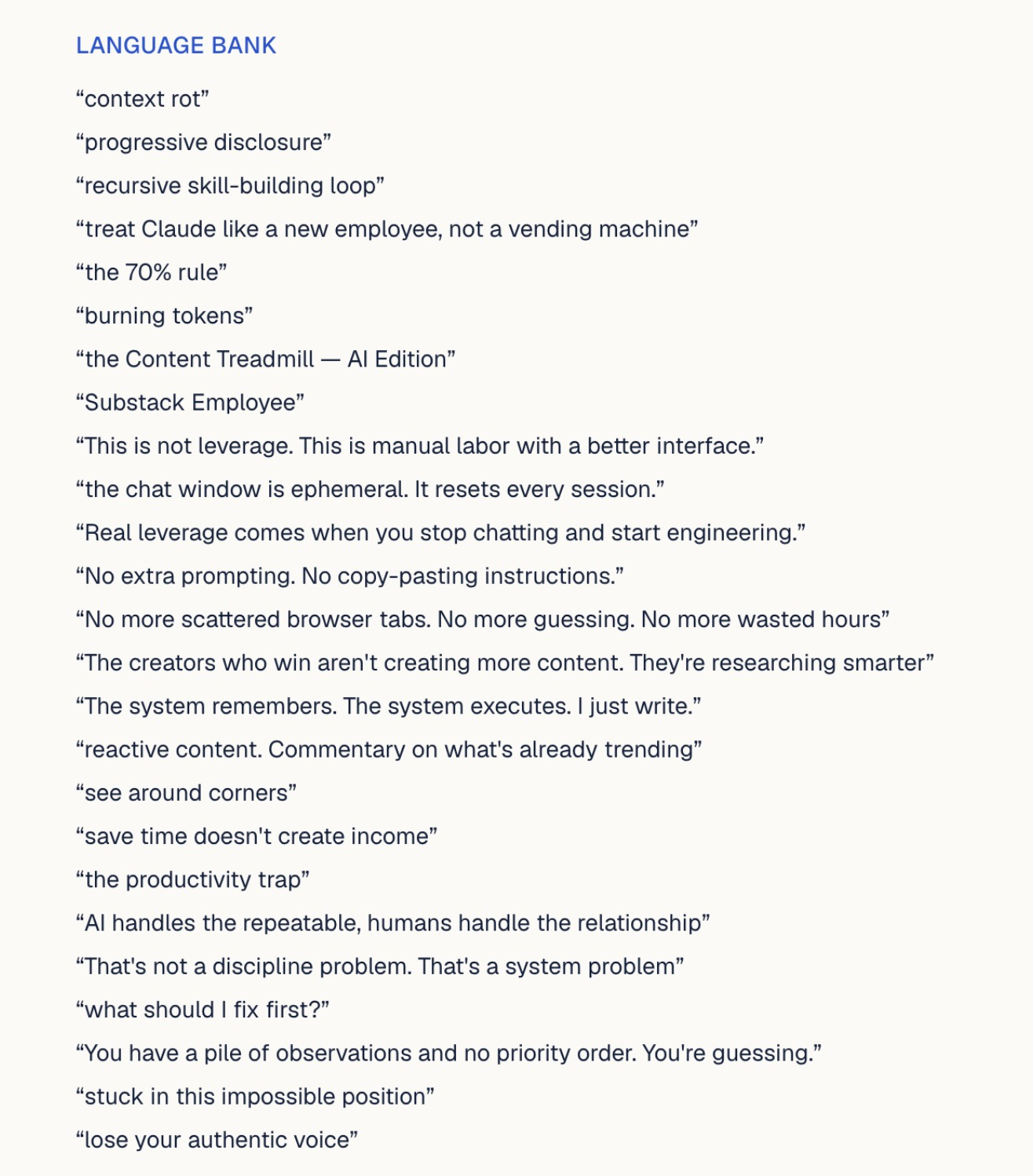
In Your Audience Has Already Written Your Sales Page, I showed what a finished language bank looks like — phrases like "the chat window is ephemeral" and "this is not leverage, this is manual labor with a better interface" pulled straight from a creator's comments and used, almost unedited, as sales copy.
I didn't show the process that gets you there. Here it is.
This takes about 45 minutes once you have a few months of published content to draw from. Less content, less time — but also less signal, so don't rush it if you're working with a thin archive.
Before you start: the one rule that matters
Copy phrases exactly as written. Do not paraphrase, tidy up grammar, or "improve" the wording as you go.
This is the single most common way this exercise gets ruined. Someone reads a comment that says "I feel like I'm just guessing every time I post" and writes down "audience feels uncertain about content strategy" instead. The second version is accurate. It's also useless — it's lost the exact texture that made the original worth extracting in the first place.
If a phrase makes you wince a little because it's blunt or ungrammatical, that's a sign to keep it exactly as it is, not a sign to fix it.
Minutes 0–10: Gather your three sources
You need three inputs, and only three:
Your DM archive. Whatever platform you get the most direct messages on — X, Instagram, LinkedIn, email. You're not reading all of it right now, just opening it so it's ready.
Comments and replies on your three to five most-saved or most-commented posts. Saves and long comment threads mean people recognized their own situation in what you published — that's exactly where language worth extracting tends to cluster.
Call transcripts or voice notes, if you have any, from times you've walked someone through your process out loud. People describe problems more loosely and more honestly in conversation than in writing, and that looseness is often where the sharpest phrases live.
If you don't have call transcripts, that's fine — the first two sources are usually enough to fill a real language bank.
Minutes 10–25: Do a first pass for recognition, not classification
Read through your sources once, start to finish. Your only job on this pass is to notice.
Every time a sentence describes a problem, a frustration, or a workaround in specific, vivid terms — not a generic complaint, but something with texture to it — copy it word for word into a doc.
Don't sort it. Don't decide yet whether it's important. Don't group it with anything else. You're building a raw pile, not an organized list. Trying to classify while you're still reading slows this step down and makes you second-guess phrases that turn out to matter later.
A rough guide for what to grab: if a sentence made you think "that's exactly how I'd describe it too" or "I've heard some version of that before," it goes in the doc.
Minutes 25–35: Tag each phrase by source
Go back through your raw pile and add one short note next to each phrase: which platform it came from, which post or conversation triggered it, and roughly when.
This step feels like overhead, but it pays off twice. First, it tells you which of your existing posts are already doing the selling for you — the ones with the most extractable language are the ones closest to your actual offer. Second, when you later write copy using one of these phrases, you'll know exactly where it came from if you ever need to reference it, quote it publicly, or check it against the original context.
Minutes 35–40: Cluster the repeats
Now look across your entire tagged pile and group phrases that describe the same underlying frustration, even when the exact wording is different.
"I feel like I'm just guessing every time" and "I never know if what I'm posting is actually going to work" are the same frustration in two outfits. Put them in the same cluster.
You're not looking for identical sentences. You're looking for the same problem, independently described by more than one person, without prompting.
Minutes 40–45: Cut anything that didn't repeat
This is the step most people skip, and it's the one that actually makes a language bank useful instead of just a long list of quotes you liked.
Go through your clusters and delete every phrase that only ever appeared once, from one person, with nothing else backing it up. It might be a great line. It might even be true of your whole audience. But you don't know that yet — one instance is an anecdote, not a pattern, and building copy around an anecdote is exactly the guessing this exercise is supposed to replace.
What survives — phrases that showed up, in some form, from more than one person, describing the same thing — is your actual language bank. Everything else was noise that felt like signal.
What to do with it once it's built
Your language bank isn't the finished product. It's raw material for offer copy, following the 70/30 split I laid out in the last post: roughly 70% your audience's exact words, 30% your framing and structure.
Don't sort your finished bank by "sounds good." Sort it by which problem it describes and how urgent that problem sounds. A phrase describing mild curiosity belongs somewhere different than a phrase describing active frustration — and knowing which is which is its own skill, one sharp enough to earn its own post. I'll cover exactly how to tell a buyer's language from a bystander's next.
If you'd rather not do the manual read-through
This exact process — reading everything you've published, extracting verbatim phrases, keeping only what repeats — is what AI Offer Crafter automates. Feed it your published content and it returns the language bank already built, clustered by theme, alongside the repeated question and the offer itself.
One-time. $29.
Frequently asked questions
How long does it take to build a language bank?
About 45 minutes if you already have a few months of published content and comments to pull from: 10 minutes gathering your sources, 15 minutes on a first read-through, 10 minutes tagging, 5 minutes clustering, and 5 minutes cutting anything that only appeared once.
What counts as "existing content" for this exercise?
Three places: your DM archive, the comments and replies under your most-saved or most-commented posts, and transcripts or voice notes from any calls where you've talked someone through your process. All three are raw records of your audience describing their problem in their own words.
Should I paraphrase the phrases I find, or copy them exactly?
Copy them exactly, word for word, including the awkward or ungrammatical parts. The moment you paraphrase a phrase, you've traded a real, proven sentence for an invented one — and invented sentences don't carry the same credibility.
How do I know a phrase actually belongs in the language bank?
It has to repeat. If a phrase or a close variant of it shows up from more than one person, describing the same underlying frustration, it's a candidate. If it only ever appeared once, it's an anecdote, not a pattern — leave it out.
Where to go from here
This post covered how to extract the language. It didn't cover how to tell which of those phrases actually signal someone ready to buy versus someone who's just venting — those two read almost identically on the page, and mixing them up means building sales copy around people who were never going to pay. The 7 Audience Phrases That Signal Buying Intent covers exactly that.