The difference in a validated offer vs an interesting idea is evidence: an interesting idea gets compliments, while a validated offer has a named buyer, a price anchored to what the problem costs them, and proof that real people paid or booked a call before anything was built.
In The 12 Questions Every Creator Offer Must Survive, I ran my own top-ranked offer through a stress test and it scored 66 out of 100. That raised a fair question from a few readers: fine, but what does the finished version look like? What's the actual difference between where that offer started and something you can honestly call validated?
Here's the same offer, before and after. And one honest caveat up front: the "after" isn't validated yet. It's testable, which is the step everyone skips.
The interesting idea
The offer was called "The Newsletter Employee," a three-agent AI system for newsletter writers built on persistent memory files, so you edit each week's draft instead of rewriting it from scratch. The tool ranked it my strongest direction, 8/10 overall.
If I'd described it to you at that stage, it would have sounded like this:
"A 3-agent AI system that remembers your voice, so newsletter writers can stop rewriting ChatGPT drafts every week. Probably around $500."
Everyone I'd say that to would nod. It's specific enough to sound real and clever enough to be interesting. And there's nothing in it that a buyer or a skeptic could check.
The validation-ready version
After the stress test and the packaging stage, the same offer had grown a spine. Here's the comparison:
| Interesting idea | Validation-ready offer | |
|---|---|---|
| Buyer | "Newsletter writers" | Solo writers with a 5k–20k list, burned by generic ChatGPT drafts, who currently use a free Notion doc of prompt templates |
| Price | "Around $500" | Three tiers: $247 self-serve, $697 cohort with calibration walkthrough, $1,497 done-with-you setup, anchored to 4–8 hours a week of rewriting |
| Proof | "It works for me" | Rated 1 out of 5 today; claims need 4 out of 5; plan is a closed beta with before-and-after drafts |
| What you do next | Build it | Email the list, open 5 beta spots at $297 |
| How you'll know | It feels good | 5+ replies asking for details or a call, and at least 3 of 5 beta spots paid within 2 weeks |
Look at the last two rows. That's the whole difference.
The five things that turn an idea into a testable offer
1. The buyer has a name, a trigger, and a current workaround. "Newsletter writers" is a market. "A solo writer who just spent another Sunday night rewriting a generic-sounding draft" is a person. The person is the one who replies.
2. The price is tied to what the problem costs, not what feels reasonable. The tool anchored the tiers to the buyer's time: 4–8 hours a week of rewriting. A price with a reason can be defended. A price that "feels right" gets negotiated down by the first skeptical reply.
3. The weak spots are written down. The stress test failed three questions: no evidence buyers pay for a solution today, no proof from real buyers, and an easy free alternative in a long-context ChatGPT project. The validated version doesn't hide those. It builds the test around them.
4. The proof is planned, not assumed. Proof level 1 of 5 means "I believe it works." Level 4 needs before-and-after drafts, hours saved, and at least two beta users willing to go on record with a specific outcome, like cutting drafting time from four hours to 45 minutes. That's a to-do list, and every item on it is something you can do before building the full product.
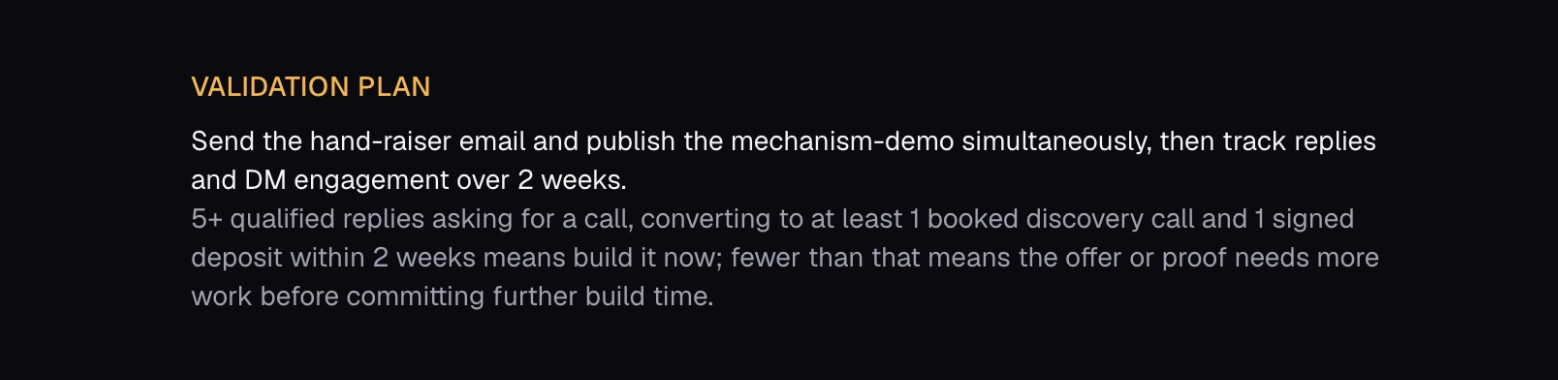
5. There's a pass/fail test with numbers. This is the one that matters most. The tool's validation plan says it plainly: five or more replies requesting details or a call, and at least three of five beta slots filled with paid commitments within two weeks. Then the line I'd put on a wall: compliments and "this looks cool" replies don't count. Only booked calls or beta payments validate demand.
Why "validated" is a result, not a description
You can't make an offer validated by describing it better. That's the trap: a well-written offer page, a clear price, and a good mechanism all make an idea look more real, and none of them change whether anyone will pay.
Validation is something buyers do to your offer. Three people pay $297 for a beta of something that doesn't fully exist yet, and now you know something you didn't. Zero people pay, and you know something too, and it cost you two weeks instead of three months of building.
That's also why the hand-raiser email in the plan is so short. It doesn't pitch a finished product. It says what's being built, that a small beta is opening, and asks for one word back: reply "IN." Low effort to send, and a reply is a real signal, not a like.
The gut-check version
If you're staring at an offer right now, ask three things:
- Can I name the specific person who'd buy it, and what they're doing about the problem today?
- Have I decided what result would make me build it, and what result would make me stop?
- Has anyone paid, pre-paid, or booked a call?
Three yeses: validated. Anything less: you have an interesting idea, which is a fine place to start and a bad place to stop. It's the same rule as The Repeated Question Is the Offer: signal over applause. Applause is what an idea earns. Money is what an offer earns.
Frequently asked questions
What is the difference between a validated offer and an interesting idea?
An interesting idea is something people react to positively. A validated offer is one where real buyers have done something that costs them: paid, pre-paid, or booked a call. The idea describes a good product; the validated offer has evidence that a specific buyer will pay a specific price for it.
How do you know if your offer is validated?
Decide the test before you run it, with numbers and a deadline: for example, five replies asking for details and three paid beta spots within two weeks. If you hit the numbers, it's validated. If you don't, it isn't, no matter how many people said it sounded great. Compliments and likes don't count as validation.
Can you validate an offer before you build it?
Yes, and that's the point. Sell a small paid beta or pilot to a handful of buyers before building the full product. Their payment tells you whether the demand is real, and the before-and-after results they give you become the proof for everyone who comes after.
What counts as validation for a creator offer?
Money and calendar bookings. Paid beta spots, pre-orders, deposits, and booked sales calls all cost the buyer something. Replies like "this looks cool," likes, and saves are interest, not validation.
Where to go from here
If you haven't stress-tested your offer yet, start with The 12 Questions Every Creator Offer Must Survive. To see the full analysis this example came from, read I Ran the AI Offer Crafter on My Own Content and Didn't Pick Its Top Recommendation.
Next in this cluster: The Most Common Reasons Creator Offers Fail Before Launch (coming soon). After that, pricing: how to set a price the buyer can defend, using the same anchoring the tiers above came from.