To write a guarantee for a digital product you haven't delivered yet, use one sentence in the form "If [specific, measurable failure condition], [specific remedy]," where the condition includes a real number and the remedy is something you can actually pay. If you can't meet both tests, the right guarantee is none.
A guarantee on an untested offer feels like a gamble. You haven't seen what happens when a stranger uses this, and you're about to promise something about it. Most creators respond one of two ways: skip it entirely, or reach for "100% satisfaction guaranteed" and hope nobody ever tests it.
Both miss the point. A guarantee isn't a vote of confidence. It's a piece of the offer that takes on a specific risk the buyer is worried about. Written well, it's a few lines of precision. Written badly, it's either invisible or a liability.
Why "satisfaction guaranteed" does nothing
"If you're not happy, I'll refund you" sounds generous and gives the buyer nothing to evaluate. There's no condition they can check. They can't tell what "not happy" means, how long they'd have to decide, or whether you'd push back. So they discount it, the same way they discount a testimonial that says "great product!"
It also leaves you exposed. If the failure condition is a feeling, every refund is a negotiation about a feeling.
A believable guarantee gives both sides something checkable. That's the whole job of the sentence.
The format: failure condition + remedy
The structure the AI Offer Crafter uses for every guarantee it recommends is deliberately simple:
If [specific, measurable failure condition], [specific remedy].
Both halves have to be grounded in this offer's outcome, deliverables, and price, not pulled from a template.
In my own case-study run of the tool, the guarantee it wrote for a $79/$197/$497 repurposing offer looked like this:
Install the Skills pack and run it on one piece of your own content within 14 days. If the output doesn't match your brand.md voice closely enough to publish with only minor edits, we'll do one free calibration session to dial it in — or refund your purchase in full.
Look at what's in there. A time window (14 days). An action the buyer takes (install and run it on one piece of content). A test of the result (publishable with minor edits). A remedy that escalates (a calibration session first, a refund as the backstop). A stranger could read that and know exactly what they're being promised and what they have to do.
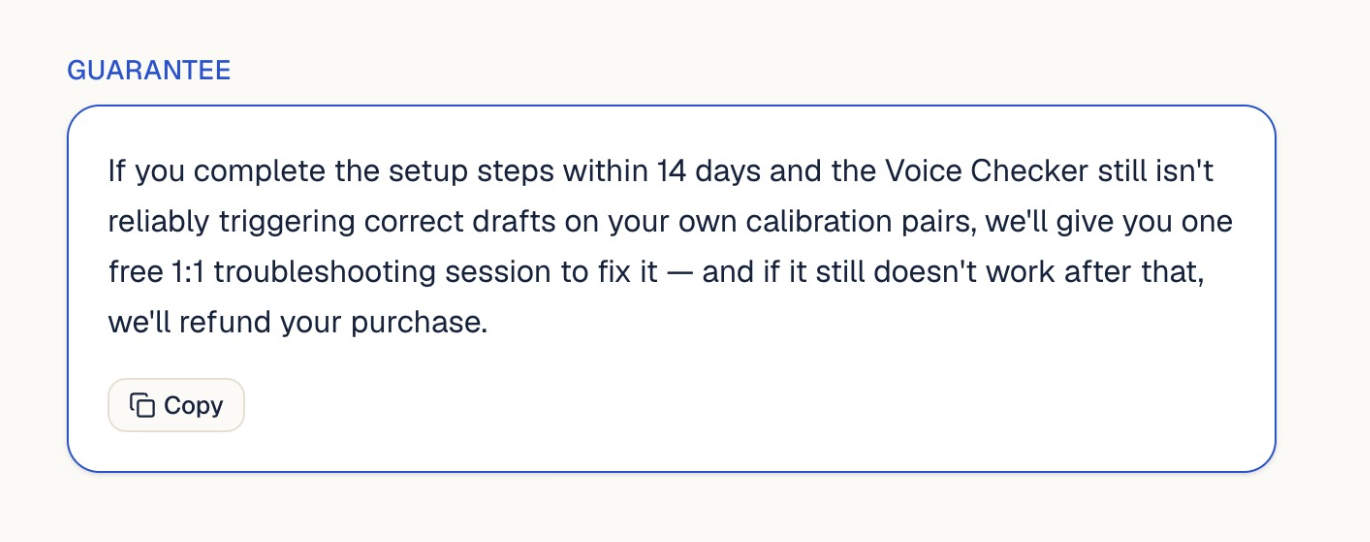
Here's another one from a separate run, same structure. The window is 14 days. The buyer's action is completing the setup steps. The failure condition is that the Voice Checker still isn't reliably triggering correct drafts on their own calibration pairs. The remedy escalates from a free 1:1 troubleshooting session to a refund if that doesn't fix it. Different offer, different product, same four moving parts.
How to write one, step by step
1. Decide whether a guarantee belongs on this offer
This comes first because it's where creators go wrong. The tool's own instruction is to decide honestly, given the price, the delivery reality, and how skeptical the market is. A guarantee that's structurally unpayable, or that undercuts a premium, high-touch offer's positioning, is worse than none.
Run three quick checks:
- Can I pay the remedy at my realistic volume? A refund is fine at $79. A "double your money back" on a $1,497 done-with-you tier isn't.
- Is the result mostly in the buyer's hands? If success depends on effort you can't verify, an unconditional guarantee invites free-riding.
- Does it fit the positioning? A premium, bounded-capacity service can read as less confident when it leads with a refund policy.
If the answers are bad, skip it. The tool can and does return recommended: false with reasoning, and that's a legitimate, useful answer. A clear "no guarantee, here's why" is better than a vague one you'd dread invoking.
2. Name the buyer's real fear
A guarantee is risk reversal, so reverse a specific risk. What is a hesitant buyer actually afraid of?
- "It won't work for my situation."
- "I'll buy it and never finish it."
- "It's a good idea but not worth this price."
These call for different guarantees. The first is a results guarantee, the second a participation guarantee, the third mostly a pricing problem the guarantee can't fix. This is the same instinct behind the buyer-already-paying question in the stress test: if you can't name what the buyer is worried about, you aren't ready to reverse it.
3. Write a failure condition with a real number
This is the half that makes a guarantee believable. It needs to be measurable: a count of qualified replies, a number of days, a specific booked call. Never something unmeasurable like "if you're not happy."
Tie it to something the buyer does, as the example above does with "install and run it on one piece of your content within 14 days." That does two jobs at once. It tells the buyer what you expect of them, and it protects you from claims by people who never opened the thing.
For an offer you haven't delivered yet, keep the condition narrow. You don't yet know how it performs across different buyers. A tight condition on a first, easily checked outcome lets you make a real promise while you learn what the offer actually does.
4. Choose a remedy you can actually pay
The remedy has to be concrete and payable given your delivery reality and price: a refund, a free rework session, extra calendar time. Not "we'll make it right."
Escalating remedies work well when you're unsure of the failure rate. Offer the fix first (one calibration session, extra weeks of access) and the refund as the backstop. Most people who hit the failure condition want it fixed, and a fix costs you less than a refund and keeps the customer.
5. Assemble and test the sentence
Put it together as "If [failure condition], [remedy]." Then run one test: could a stranger tell, without asking you, whether the condition was met? If they'd need to message you to find out, it isn't specific enough yet.
Finally, make sure it matches the offer. Your guarantee is a claim, and the proof level your offer requires rises with the strength of the promise. A guarantee can substitute for some proof on a low-priced offer, because the buyer's downside is small. It doesn't replace proof on a high-priced one.
When the right answer is no guarantee
Three situations where I'd skip it:
The result depends mostly on things you can't see. A coaching or accountability program where outcomes turn on the buyer's effort can't be guaranteed honestly. Guarantee your side (sessions delivered, response time) if you want to, not their result.
The remedy would hurt you. If a refund wave would genuinely sink the launch, the guarantee is a risk to you dressed up as a gift to the buyer.
It would make a premium offer look nervous. A high-touch, limited-capacity offer sells on selectivity. A refund policy front and center can undercut that.
If you skip it, say why plainly where the buyer will look. "No refunds, but here's the free preview, the sample output, and exactly who this is not for" is a more honest risk-reducer than a guarantee you'd wriggle out of.
Common mistakes
Guaranteeing a feeling. "Love it or your money back" has no condition anyone can check. Replace the feeling with an observable result.
Promising a result you don't control. "Guaranteed to get you 100 customers" is a promise about the market. Guarantee an action and its direct outcome instead.
A remedy with no ceiling. If you haven't done the math on what happens when many buyers invoke it, don't publish it.
Copying a guarantee from another offer. A condition that fits a $500 course doesn't fit a $29 template pack. Rebuild it from your price and your delivery.
Frequently asked questions
Should a new creator offer have a money-back guarantee?
Not automatically. A guarantee helps when the buyer's main fear is that it won't work for them and you can pay the remedy without hurting yourself. It hurts when the failure can't be measured, the remedy can't realistically be paid, or it undercuts a premium, high-touch offer's positioning. "No guarantee" is a legitimate decision, not a gap.
What makes a guarantee believable to a buyer?
A specific, measurable failure condition and a concrete remedy. "If you're not happy" gives the buyer nothing to hold you to, so they discount it. "If you do X within 14 days and Y doesn't happen, I'll do Z" reads as a real commitment because both halves can be checked.
What is a good guarantee format for a digital product?
If [specific, measurable failure condition], [specific remedy]. The condition needs a real number such as a count, a number of days, or a booked call. The remedy should be something you can actually deliver, such as a refund, a free rework session, or extra time.
Can I offer a guarantee before I have any customers?
Yes, if the failure condition is tied to something the buyer does and you can measure, and the remedy is affordable at your expected volume. A guarantee on an untested offer should be narrow and conditional on the buyer completing the work, which also protects you while you learn what the offer really does.
Where to go from here
To see how a guarantee, price, and proof fit together in a real output, read I Ran the AI Offer Crafter on My Own Content. For the price the guarantee has to be affordable against, start with Why Creator Pricing Is Almost Always Wrong, and for the proof that backs the promise, How to Build Proof for an Offer You Haven't Launched Yet.
Have AI Offer Crafter decide whether your offer needs a guarantee →