To build credibility for a new offer, don't collect more proof at random: work out which of five levels of proof your price and promise actually require, then gather exactly the evidence that closes the gap between that level and the one you're at today.
The 12 Questions Every Creator Offer Must Survive flagged proof beyond your own experience as one of the questions offers fail most often. The pricing cluster ended on the same pressure point from the other side: once you've anchored a price against what the problem costs the buyer, the price is now making a claim, and claims need evidence. This post is about how much evidence, and of what kind.
The common advice is "get testimonials." It's not wrong. It's just not specific enough to tell you what to do on Monday morning, or when to stop.
Proof is a ladder, not a pile
Most creators treat proof as a quantity. More testimonials, more screenshots, more case studies, and eventually the pile is tall enough to charge. That framing hides two problems.
First, proof isn't uniform. A kind note from a friend and a documented before/after from a stranger are both "a testimonial," and a skeptical buyer weighs them nothing alike. Second, there's no stopping rule. If proof is a pile, you're never done, which is how creators end up "not ready" for a year.
AI Offer Crafter's packaging stage replaces the pile with a hierarchy: five levels, each stronger than the last.
- Product/output proof. The thing itself works, and you can demonstrate it. A working system, a sample output, a live walkthrough.
- Customer proof. Someone other than you has used it. It doesn't have to have worked spectacularly. A real person ran it.
- Outcome proof. It produced the specific result being promised, for someone, with a number or a concrete before/after attached.
- Comparative proof. It beats the alternative the buyer would otherwise use, shown side by side.
- Authority proof. External credibility: recognized names, publications, credentials, or audience scale that predate the offer.
Each level answers a harder question from the buyer. Level 1 answers "does this exist?" Level 2: "has anyone actually used it?" Level 3: "did it work?" Level 4: "is it better than what I'm already doing?" Level 5: "why should I trust you in the first place?"
Two numbers, not one
Here's the part that changes what you do. The tool doesn't produce a single proof score. It judges two separate things:
- Current proof level is the highest level your gathered evidence genuinely supports, not the highest level you wish it supported.
- Required proof level is the level your offer's own claims demand, given its price and the transformation it promises.
The finding that matters is the gap between them. Proof is only "enough" relative to what you're asking the buyer to believe. A $47 template pack that promises "a starting point" is fully served by level 1. A $697 program promising a specific measurable result is making a level-3-or-4 claim, and level-1 proof leaves that claim standing on nothing.
That's why "I need more proof" is usually the wrong diagnosis. You might have plenty of the wrong level.
What a real gap looks like
The packaged offer from the case study is a good worked example. It's a system for newsletter writers who rebuild their voice in a blank AI chat every week, with a core tier priced at $697, anchored against roughly $7,800 a year of that workaround's cost.
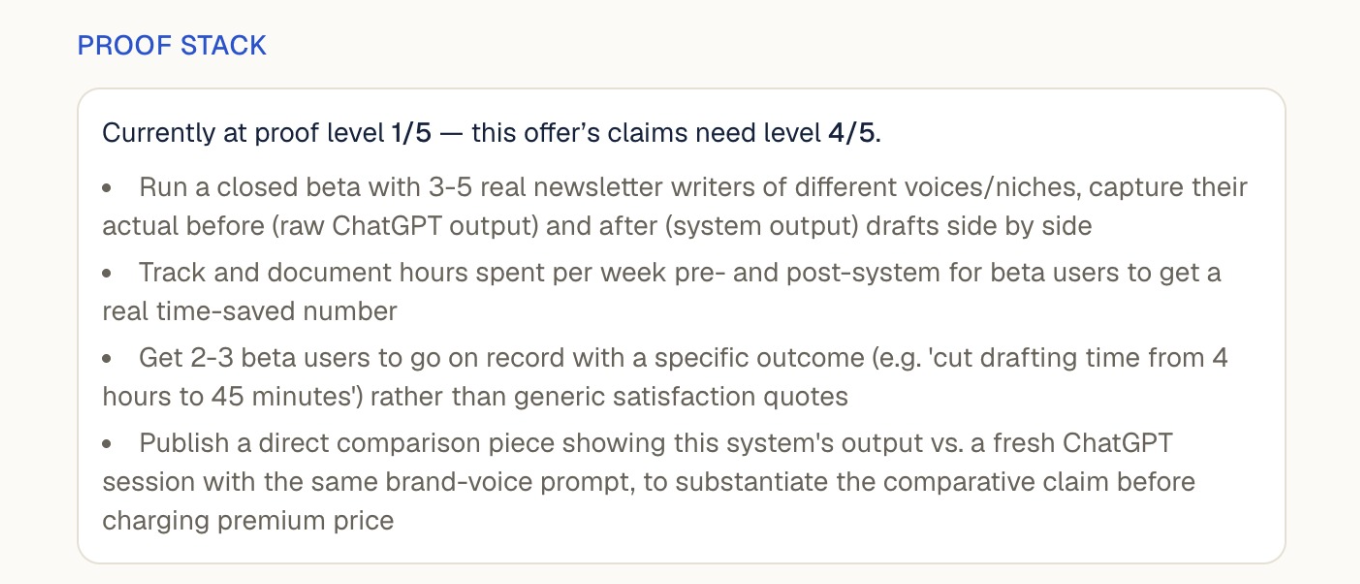
The proof stack the tool generated opens with a single line: "Currently at proof level 1/5. This offer's claims need level 4/5."
Beneath it, the tool sorts what exists from what doesn't:
- Direct proof: none in hand. No documented before/after drafts from a real buyer using the system.
- Adjacent proof: the creator's own use of the system on their own newsletter, plus past experience building AI workflows.
- Authority signals: existing newsletter audience and prior public writing on AI workflows.
- Missing, go gather this: third-party testimonials, a before/after comparison of draft quality, hard data on time saved per week for an actual buyer, and evidence the method works across different writing voices rather than just the creator's own.
Notice what this is not. It isn't "build more credibility" or "get social proof." It's a specific inventory, and it names the exact reason the offer's $697 claim isn't yet supported: everything on the ledger comes from the creator's own use, and the offer promises something for other people's voices.
The gap becomes a to-do list
A gap with no instructions is just bad news. The tool pairs it with proof_gap_actions, concrete experiments rather than aspirations. For this offer:
- Run a closed beta with 3-5 real newsletter writers of different voices and niches, capturing raw-AI drafts and system drafts side by side.
- Track hours spent per week before and after, to produce a real time-saved number.
- Get 2-3 beta users to go on record with a specific outcome ("cut drafting time from 4 hours to 45 minutes") instead of a generic satisfaction quote.
- Publish a direct comparison piece, system output against a fresh chat session with the same prompt, to substantiate the comparative claim before charging the premium price.
Look at what each action does on the ladder. The beta cohort moves the offer from level 1 to level 2. The time tracking and on-record outcomes produce level 3. The published side-by-side is level 4. That's the whole path from 1/5 to 4/5, and every step is something the creator can start this week with 3-5 people.
Why this also changes how you launch
The proof diagnosis doesn't just tell you what to collect. It tells you which acquisition moves are premature.
In the same offer package, the tool's acquisition strategy rates cold outreach as premature at the current proof level: cold prospects have no reason to trust an unproven system at $697, so the advice is to hold it until beta data exists, then use that data as the opener. What it recommends instead is the move that doubles as proof generation, a live public demonstration of the mechanism, which works for organic audiences who already trust the creator and produces the level-1-to-2 evidence the offer is missing.
This is the practical payoff of a hierarchy. A creator without one tends to do one of two things: launch cold at full price with no proof and conclude the offer "doesn't convert," or delay for months waiting for an undefined amount of credibility. With a required level and a current level, the question becomes narrow and answerable: which channels can this proof level support today, and what's the next piece of evidence that unlocks the next channel?
Common mistakes when building proof
Counting testimonials instead of leveling them. Ten "this was great!" quotes are ten pieces of level-2 proof. They don't add up to level 3. Level 3 needs a result, so ask beta users for the specific before/after, not whether they liked it.
Using your own results as customer proof. Your own use of the offer is real, and it's worth something, but it's adjacent proof. The buyer's question is whether it works for them, and your results don't answer that on their own. The tool files it under adjacent for a reason.
Aiming at level 5 first. Authority feels like the ultimate proof, so creators chase press mentions and credentials before they've run the offer past one stranger. Authority gets people to look. It doesn't substitute for outcome proof once they do.
Skipping the required-level check. If you only measure what you have, you can't tell whether it's enough. Always read your price and promise first and set the target before you gather anything.
The one-sentence version
Proof isn't a pile you keep adding to. It's a ladder with five rungs, your price and promise decide how high you need to climb, and the gap between where you stand and where the offer demands is the only thing worth working on.
Frequently asked questions
How do you build credibility for a new offer with no customers yet?
Start by diagnosing which level of proof you already have, then gather only the next level your price and promise require. The five levels, weakest to strongest, are product proof (it works), customer proof (someone besides you used it), outcome proof (it produced the promised result), comparative proof (it beats the alternative), and authority proof (external credibility). A closed beta of 3-5 real users, with before/after results captured, moves most new offers from level 1 to level 3.
What is a proof hierarchy?
A proof hierarchy is a ranking of evidence types by how much a skeptical buyer should trust them. AI Offer Crafter uses five levels: product/output proof, customer proof, outcome proof, comparative proof, and authority proof. Each level is stronger than the one before, and an offer's price and promise determine how high it needs to climb.
How many testimonials do I need before launching an offer?
The count matters less than the level. Ten generic satisfaction quotes are still customer proof (level 2). Two or three users who go on record with a specific measured outcome, such as cutting drafting time from 4 hours to 45 minutes, are outcome proof (level 3), and that is what a higher-priced offer with a specific promise actually needs.
Can I launch an offer before I have the proof it needs?
Yes, but price and promise have to match the proof you have. At a low price with a modest claim, level 1-2 proof can be enough. If the offer promises a specific measurable result at a higher price, either gather the missing proof first, run a closed beta at a reduced price to collect it, or soften the claim until the proof catches up.
Where to go from here
If you haven't yet, read The 12 Questions Every Creator Offer Must Survive to see where proof sits among the other ways an offer fails, and Why Creator Pricing Is Almost Always Wrong for how the price creates the claim that proof has to back up.
Next in this series: how to run the closed beta that produces level-2 and level-3 proof, and how to turn what it captures into proof a stranger will believe (coming soon).