Voice of customer for creators isn't a market-research exercise — it's the exact phrases your audience already used in your DMs and comments, sitting there unused while you write sales copy from scratch.
A few months ago I went back through the comments on a post I'd written about building AI agents. One line kept showing up, worded almost identically, from people who had never spoken to each other:
"The chat window is ephemeral. It resets every session."
Nobody told them to say that. They arrived at that phrase independently, describing the same frustration in almost the same words, because it's exactly how the problem feels from the inside.
I hadn't written a word of sales copy yet. My audience had already written the first line of it for me.
I've sold over 1,300 digital products and built an audience past 75,000 on X without ever running a focus group or paying for market research. Every piece of language I've ever used to sell something came from the same place: reading back through what people had already said to me, and noticing what kept repeating.
"Voice of customer" sounds like a corporate research term. For a creator, it's just your inbox.
Companies spend real money on this. Focus groups. Surveys. Analysts hired to interview customers and extract patterns from the transcripts.
You already have the transcripts.
Every DM you've answered, every comment under your posts, every reply to your newsletter is a customer interview you already ran — for free, without meaning to, over months or years of publishing. The only thing missing is someone going back through it and pulling out the phrases that repeat.
That's the entire discipline. Not inventing language that sounds persuasive. Finding the language that's already proven itself, because a real person under real frustration reached for those exact words without being prompted to.
Why this matters more than the offer itself
You can have the correct offer — the right repeated question, the right person, the right price — and still watch it underperform because the copy describing it sounds like every other launch email in your reader's inbox.
Here's the test. Read these two lines:
Generic: "Automate your content workflow with AI agents that save you time."
Their language: "The chat window is ephemeral. It resets every session. Stop burning tokens re-prompting from scratch — build the system that remembers."
The first line could describe a hundred different products. It's true, but it's not specific to anyone.
The second line only makes sense to someone who has already lived the exact frustration it names. If you've felt that — the reset, the re-prompting, the tokens disappearing into nothing — that sentence doesn't read as marketing. It reads as someone who already understands your problem better than you've articulated it yourself.
That's the entire mechanism behind why voice-of-customer copy converts. Not cleverness. Recognition.
What a real language bank actually looks like
When I ran a creator's published content — newsletter posts, threads, comment replies — through AI Offer Crafter, it pulled together a language bank of the exact phrases that kept recurring across their content. Not a summary. Not a theme. The verbatim words.
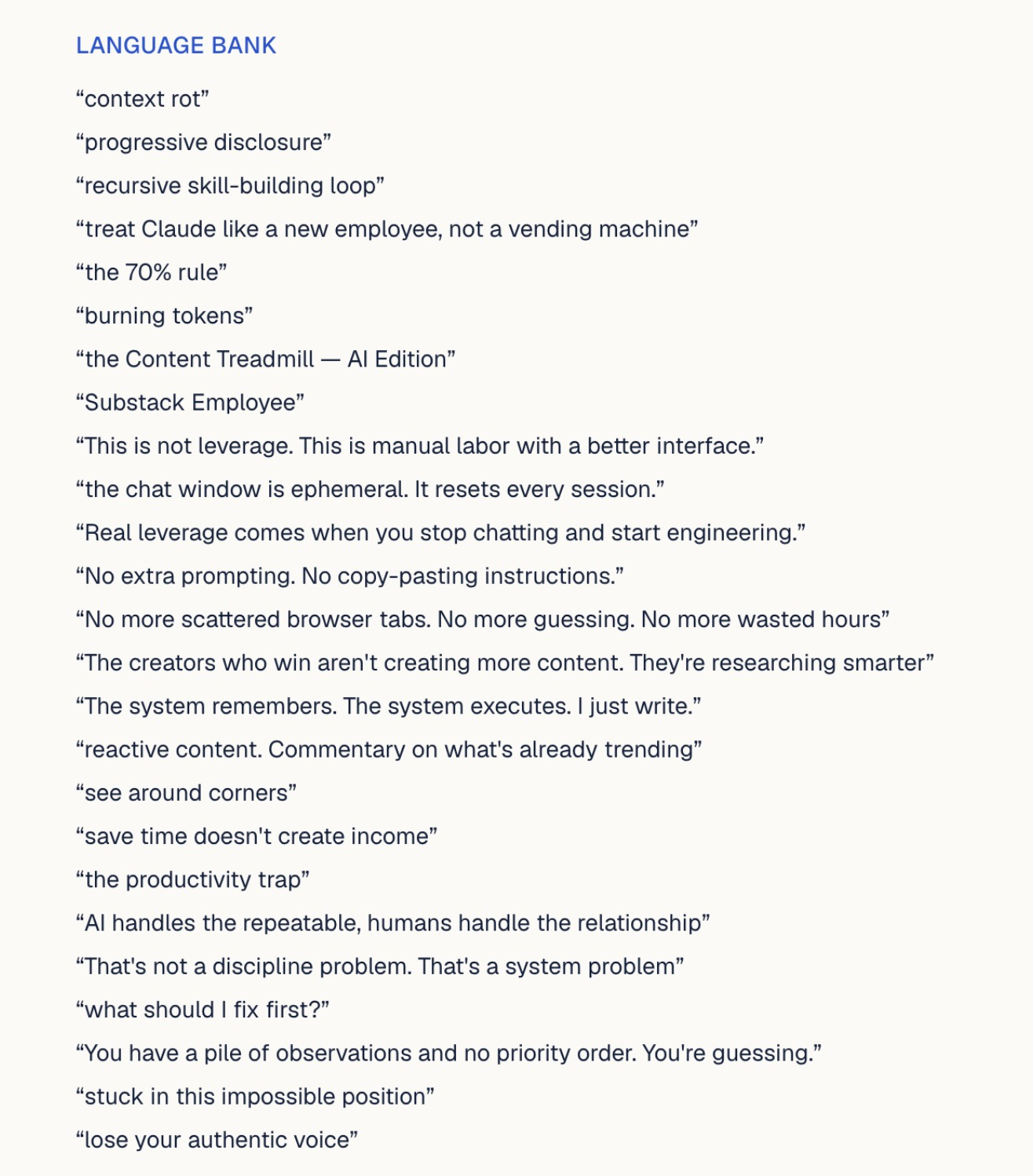
Some of what came back, word for word:
- "context rot"
- "treat Claude like a new employee, not a vending machine"
- "burning tokens"
- "This is not leverage. This is manual labor with a better interface."
- "Real leverage comes when you stop chatting and start engineering."
- "The system remembers. The system executes. I just write."
- "That's not a discipline problem. That's a system problem."
None of that is copywriting. It's language this creator's audience had already been using — in replies, in comments, in the way the creator themselves described the problem when they weren't trying to sell anything.
And that's exactly why it works as sales copy. Nobody wrote "That's not a discipline problem. That's a system problem" to be persuasive. It got written because it was the truest, most compressed way to describe a real frustration. Persuasive language written on purpose almost never lands that cleanly. Language that emerges under real frustration usually does.
The 70% rule
Here's the practical guideline I use: offer copy should be roughly 70% your audience's vocabulary, 30% your framing.
That ratio isn't arbitrary — it's a check against the natural pull toward polishing. Every creator's instinct, once they've collected real phrases, is to smooth them out. Make them sound more "professional." Round the edges off.
Resist that. The edges are the point. "Burning tokens" is more specific and more credible than "wasting resources." "The chat window is ephemeral" is more vivid than "the AI doesn't retain context." Every time you polish a real phrase into a generic one, you're trading proof of understanding for the illusion of professionalism — and the trade goes the wrong way.
Your 30% is structure: the headline that frames the problem, the paragraph that connects it to the offer, the call to action. Your audience's 70% is what makes all of it believable.
The mistake: editing the rough edges out
Here's how this usually goes wrong. A creator does the work — pulls real phrases from real comments — and then, sitting down to actually write the sales page, can't resist tidying them up.
"That's not a discipline problem. That's a system problem" becomes "Our solution addresses systemic workflow inefficiencies."
"Burning tokens" becomes "inefficient resource utilization."
"The chat window is ephemeral. It resets every session" becomes "Standard AI tools lack persistent memory."
Every one of those edits is a downgrade dressed up as an improvement. The rewritten version is grammatically cleaner and persuasively weaker, because it's traded a phrase a real person reached for under real frustration for a phrase that sounds like it came from a template. The reader can feel the difference even if they couldn't explain it — one version sounds like someone who's been where they are, and the other sounds like software.
If a phrase you pulled from a comment or DM makes you wince a little because it's blunt or unpolished, that's usually a sign to keep it exactly as it is, not a sign to fix it.
Where this language actually lives
You don't need a tool to start collecting this. You need three places to look, and the discipline to write down exactly what you find — not your polished version of it.
Your DM archive. Scroll back through the last few months. Anywhere someone described their situation in detail — not just asked a question, but explained why they were asking — copy the sentence exactly as they wrote it.
Comments and replies on your most-saved content. Saves mean someone recognized their own problem in what you published. Read the comments under those specific posts and look for repeated phrasing, not just repeated topics.
Calls, voice notes, and any place you've talked someone through your process out loud. People describe their problems more loosely and more honestly in conversation than in writing. If you've ever gotten on a call with someone and they said something like "I feel like I'm just guessing every time" — that unscripted sentence is worth more than anything you'd write in a sales page draft.
I walk through the full extraction process — how to actually pull this out of months of scattered content without it taking a weekend — in How to Build a Language Bank From Your Existing Content. And once you have the language, there's a smaller, sharper skill worth learning on top of it: which of those phrases signal someone who's ready to buy, versus someone who's just venting. That's worth its own post too, because the two look almost identical on the page and only one of them is a buyer.
What to do today
Pick your three most-commented or most-saved posts from the last few months.
Read every comment and reply. Don't summarize them in your head — copy the exact sentences that describe a problem, word for word, into a doc.
Then look at whatever sales copy you currently have — for an offer, a waitlist, even just your bio — and count how many of those exact phrases show up in it.
If the answer is close to zero, that's not a writing problem. It's a listening problem. And it's the easiest one on this list to fix, because the words are already sitting there, in your own comments section, waiting to be used.
If you'd rather skip the manual read-through, AI Offer Crafter builds the language bank automatically from everything you've published, alongside the repeated question and the offer itself. One-time. $29.
Frequently asked questions
What does voice of customer mean for a creator?
It means the exact words your audience already uses to describe their problem — in DMs, comments, and replies — instead of the polished, generic language a creator would normally reach for when writing sales copy. For a creator, voice of customer isn't a research project. It's already sitting in your inbox.
Why should I use my audience's exact words instead of my own?
Because recognition sells better than persuasion. When a reader sees their own phrase reflected back at them in your offer copy, it proves you understand their specific problem — which reads as more credible than any generic marketing claim you could write, no matter how well-crafted.
How much of my offer copy should be my audience's own language?
Aim for roughly 70% their vocabulary and 30% your framing. The bulk of the persuasive weight should come from phrases you can point to in an actual comment or DM — your job is mostly arrangement and structure, not invention.
Where do I find my audience's actual words?
Three places: your DM archive, the comments and replies under your most-saved posts, and any calls or voice notes where you've walked someone through your process. All three are raw transcripts of your audience describing their own problem in their own words.
Where to go from here
Finding your repeated question in The Repeated Question Is the Offer tells you what to build. This post is about how to talk about it once you know.
Next in this cluster:
- How to Build a Language Bank From Your Existing Content — the practical extraction process
- The 7 Audience Phrases That Signal Buying Intent — how to tell a buyer's language from a bystander's
Your sales page is already half-written. It's just scattered across a few hundred comments instead of collected in one place.